Wednesday, January 26, 2011
Domesticity: the Modern Woman's Dilemma
Friday, January 14, 2011
The Canine Commuter
Monday, December 13, 2010
Un Anniversaire for the Grownups

When I was Two,
I was nearly new.
When I was Three
I was hardly me.
When I was Four,
I was not much more.
When I was Five,
I was just alive.
But now I am Six,
I'm as clever as clever,
So I think I'll be six now for ever and ever.
Thursday, July 8, 2010
Ballistics Experts
I have never thought of myself as a particularly relaxed or dignified person, but in moments like these, it gives one pause to stop and consider. Is this what the future looks like?
When my youngest brother Bruce was about 10 years old, he was bemused to learn the meaning of the phrase "going ballistic." (My personal favorite illustration of the subject comes from the John Hughes' classic Ferris Bueller's Day Off: for fans of the film, please recall the scene in which the disaffected younger sister, played by Jennifer Grey, drop kicks Principal Rooney to the face and runs screaming up the stairs.) Bruce learned the term from our next-door neighbor Sina, who was using it in reference to his mother. Mothers, I allow, are experts in the field of "going ballistic." Ballistic, as any good English major can tell you, comes from the root word for the science of guns and explosions. The association, I think, is a great one, and it's a great turn of phrase. And, as Miss Grey and mothers bring into the mix, I think it's a particularly apt descriptor of hysterical women.
Which brings us back to the romcom genre. In every romcom there has to be a reason why a perfectly attractive and successful girl is single, right? Hence the character type: the uptight single girl. She works in writing or editorial, she's hyper organized, she flosses a lot, she hasn't been on a date in a really long time, etc. And her easily-tripped threshold of uptightness provides the writer and director with plenty of options to have her "go ballistic" in any number of sitcom scenarios.
All further proof that I was destined to be a romcom heroine. As a professional editor, I get paid to be anal retentive. Which is why I feel so terrifically lucky to have a job that I really enjoy. I've started recreationally proofing menus at restaurants, and pretty much any advertisement I read, I rewrite the tag line over and over again in my head until I'm happy with it. I make my boyfriend endure all sorts of hysterical fits, such as, say, bursting into tears over a failed chicken pot pie (they were very expensive wild mushrooms, for the record), or accidentally lighting one's own cookbook on fire. And I'm not particularly proud to admit that I've started down the path of compulsive cleaning. Which is just a tad disturbingly similar to my mother, enthusiastic organizer of sock drawers.
Next thing you know, I'll be hunched amid piles and piles of papers and words, pencil clenched in teeth, maniacally typing away. I'm not arguing that this is healthy. I'm just saying, well, first of all, it's inevitable, and second of all, isn't it just a tad... romantic? In the really uptight, but still adorable kind of way?
Thriving on the perfection of the details: it may seem like minutiae to the rest of you, but rest assured, for us lowly assistant editors and aspiring romantic stereotypes, well! I dare say it's a lifelong passion.
Sunday, June 27, 2010
Miss Austen
First of all, in follow up to my rather angsty post from rather (ahem) a while ago, yes, in fact, I have now moved to San Francisco and have been living here yea so many months. If you will permit a gush: it is absolutely lovely. In addition to getting to pretend that you are like Jane Eyre walking out into a bracing onslaught of summer fog every day upon leaving the office (not great for the bangs, but one must compromise), I also feel that I have reached the closest degree that I perhaps ever shall in my life of resembling the heroine of a romantic comedy--or romcom, as my brother Jason, who knows such things, calls them. I submit the following evidence: I am a twenty-something educated woman. I work in editorial (I am delighted to conclude that nearly all romcom heroines work in either newspaper, magazine, or book publishing--consider your favorite films, and prepare to be amazed). I am fairly uptight, another key characteristic to many of these women (I'd like to think charmingly uptight, but won't push it). Clearly nothing is left but for me to start dressing in suspiciously unaffordable designer clothing, get put on a ludicrous writing assignment or get my stiletto stuck in a steam grate, and prepare to be swept off my feet by the man of my dreams who I don't actually like that much at first but ends up irresistably stealing me from my current boyfriend anyways meanwhile all of the subplots with my quirky friends wrap up in similarly satisfactory manner. Not that I've been, you know, thinking about this too much.Ah, the delights and delusions of romance! Which brings me back to perhaps my favorite, dare I say, pioneers of the genre: Miss Jane Austen.
My dear friend Killeen, fellow English major now staggering through the world at large, invited me, roughly a year ago, to join a Jane Austen book club. Who could refuse such an offer? Someone made of stronger stuff than I. It was readily accepted, and six novels and six meetings later, I now delight in telling people that I have read the complete works of Jane Austen. In fact, I slip it into conversation whenever I can. I dare say it feels so good that I may start reading the complete works of other authors, so I can start saying that, too.
Despite feeling a bit like my mother (member of two book clubs), the experience on the whole was pretty top notch. Suffering from some withdrawal from the classroom, it was a delight to whip out the critical editions, start perusing introductions and footnotes, and underline and annotate away. Moreover, the novels themselves are such a pleasure--there is no other word for it--that left me, for one, audibly gasping, giggling, and in general severely annoying my boyfriend, who always wanted to know what had happened and was inevitably disappointed with the results.
"Mr. Elton is 'violently making love to her' in the carriage! Oh my god oh my god oh my god!!"
"Wait--what? I thought they couldn't do that in these books."
"No, no! Don't be an idiot. He picked up Emma's hand and told her that he is madly in love with her!"
"He just picked up her hand?"
And so on.
We chose to take the roughly chronological approach, meaning we began with Northanger Abbey, and proceeded with Sense and Sensibility, Pride and Prejudice, Mansfield Park, Emma, and finally Persuasion. Northanger reads a bit young, although still charming. By S & S, I was sure it had to be my favorite. By P & P, I knew that I had been a complete dunce and clearly this was my favorite. I was a bit shocked to find that my club members preferred Persuasion to Emma (seriously, no contest in my mind), but we were all in accord when it came to Elizabeth Bennet clearly being the most easily imagined as one's best friend, and the outrageously arrogant Darcy reigned among our hearts. Personally, I place the wise Mr. Knightley second.
Reading (and becoming completely entranced with) Austen, I find myself wishing for the same delicacies today, where crossing a room can be a statement, visiting or not visiting a certain person at a certain time a huge affront or unanswerable kindness, and a short note containing but a few words can mean the absolute world. Austen's characters are so measured in what they do and what they speak; every word and phrase and gesture is important. It is a drama of the details, and when I sometimes think about what little care people seem to put into the emails that they write, and in general our comportment towards others, nowadays, it makes me wonder if Austen would share my occasional frustrations. What would Austen think of my friends who don't return phone calls, or make themselves presumptuously difficult over invitations, hm? Her relentless harping on faults of character gives us license to indulge in a critical eye ourselves, although, to be fair, her fascination with improvements of character probably ought to keep us a bit in check, as well. I favor the former over the latter.
Ah, but the pleasures of novel reading! All of these details culminate in such sighs and moans and ecstasy, that if you are one to subscribe to the drama of blushes and loaded glances across drawing rooms, it is a potent combination indeed. There is an unapologetic commitment to pleasure, that I adore in Sense and Sensibility in particular--in the way that Marianne Dashwood cannot be persuaded to stop going on long, moody walks in bad weather, or in my favorite speech performed by the scandalous Mr. Willoughby: "I have three unanswerable reasons for disliking Colonel Brandon: he has threatened me with rain when I wanted it to be fine, he has found fault with the hanging of my curricle, and I cannot persuade him to buy my brown mare." [Sense and Sensibility, p. 53, Penguin Classics 1995]
It is gripping, swoon-worthy stuff, and I hang on every word of Miss Elizabeth Bennet's, as she really lets Darcy have it following his outrageously offensive (first) proposal of marriage:
"From the very beginning, from the first moment I may almost say, of my acquaintance with you, your manners impressing me with the fullest belief of your arrogance, your conceit, and your selfish disdain of the feelings of others, were such as to form that ground-work of disapprobation, on which succeeding events have built so immoveable a dislike; and I had not known you a month before I felt that you were the last man in the world whom I could ever be prevailed upon to marry." [Pride and Prejudice, p. 188, Peguin Classics 1996]
How wrong she is! How right she is! And then Darcy continues to be awful but you love it and he leaves and she's torn and I crumple into a fit of agony and delight upon the floor.
My dear Miss Austen--forgive us our vulgarities, our indelicacies, our live-in boyfriends. Because we are, ever faithfully,
Yours,
Becky Duffett
Terminal Romantic and Fool in Love
Wednesday, January 27, 2010
An Ode to Craigslist

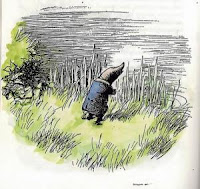
We others, who have long lost the more subtle of the physical senses, have not even proper terms to express an animal's inter-communications with his surroundings, living or otherwise, and have only the word "smell," for instance, to include the whole range of delicate thrills which murmur in the nose of the animal night and day, summoning, warning, inciting, repelling. It was one of these mysterious fairy calls from out the void that suddenly reached Mole in the darkness, making him tingle through and through with its very familiar appeal, even while yet he could not clearly remember what it was. He stopped dead in his tracks, his nose searching hither and thither in its efforts to recapture the fine filament, the telegraphic current, that had so strongly moved him. A moment, and he had caught it again; and with it this time came recollection in fullest flood.
Home! That was what they meant, those caressing appeals, those soft touches wafted through the air, those invisible little hands pulling and tugging, all one way! Why, it must be quite close by him at that moment, his old home that he had hurriedly forsaken and never sought again, that day when he first found the River! And now it was sending out its scouts and its messengers to capture him and bring him in. Since his escape on that bright morning he had hardly given it a thought, so absorbed had he been in his new life, in all its pleasures, its surprises, its fresh and captivating experiences. Now, with a rush of old memories, how clearly it stood up before him, in the darkness! Shabby indeed, and small and poorly furnished, and yet his, the home he had made for himself, the home he had been so happy to get back to after his day's work. And the home had been happy with him, too, evidently, and was missing him, and wanted him back, and was telling him so, through his nose, sorrowfully, reproachfully, but with no bitterness or anger; only with plaintive reminder that it was there, and wanted him.
Monday, December 28, 2009
On Friends
The young graduate experiences a shift in his or her immediate relationships. In some ways, this is of course expected. Apartments are rented, roommates selected or avoided, housemates are coordinated, and parents are once again solicited for support (typically with the assurance of brevity under their roof). Friends disperse and move away, or the graduate him or herself moves away, setting up in a new city. And of course, boyfriends and girlfriends are broken up with, face increased phone bills, buy webcams, move in together, or get separate places, and in general learn to see and hear less or more of each other, as the many various cases may be.
Yet beyond the sheer logistics of finding new jobs and housing and cell phone plans—and beyond the immediate heartbreak of partings—a subtle change begins to affect how the recent graduate relates to others. There is a lesser-marked sea change, which I have encountered in my experience. It seems to me that it has something to do with shifts in schedules, priorities, and much to do with the loss of a contained campus. No matter how busy the student’s life may be, I would argue that this is a shared life: to some degree, it obeys the same clock, calendar, and geography. The beauty of the campus is that it provides a bounded space and culture: no matter what your own path may take, friends are all around, all the time, in every day and class and exam and dorm and dining hall.
The graduate, however, experiences an individuating phenomenon.
For me, I stayed in Palo Alto. I said goodbye to most, though hardly all, of my Stanford acquaintance, and I moved in with my boyfriend in a small, one bedroom apartment, a matter of a biking distance from the University. My boyfriend, you see, is still a graduate student.
I was ecstatic about this change, and I still am. Stephen is by far the best roommate I’ve ever had. He’s quiet and I’m comfortable with quiet; he deals with my hysterical bouts better than any friend of mine I’ve ever known (largely, I suspect, due to the fact that girls tend to feed off of other girls’ hysteria—but I digress). Despite some difference of opinion regarding the correct frequency for doing dishes, we work well together. And, lest I fail to mention, it is possibly the most wonderful and satisfying feeling in the world to get to share your life with someone you love.
So we moved in, and I reorganized my bookshelf, and I started a new job. And before long, I felt isolated. Despite the fact that I had a boyfriend turned roommate, many friends nearby in apartments, and friends still on campus, life was suddenly much, much lonelier. I achingly wished I could simply stroll down the hall and flop on Alyssa’s beanbag as often as I wanted. I missed being able to count that I’d sit by Killeen in Chaucer and naturally could have lunch with her afterwards. Now, I had to call my friends. I had to set things up.
Setting things up seems very, very simple. It’s remarkable how big of a deterrent it can be to people of my age level. In my life as a recent graduate, I’ve become aware that to a greater or lesser degree, every time I want to see a friend, I have to organize and make it happen. And accordingly, it has become very clear to me which of my friends are actually capable of doing this and willing and able to put in the effort (as little as the occasion may require!), and which are simply not. Some friends are good at this. Some are utterly miserable. None are perfect.
Some embrace social planning whole-heartedly. I would include myself in this group. We’re all about our Gcals, we respond promptly to emails, when we receive a suggestion or an invitation, we don’t just say “Sure!” we say “When?” and “Where?” Others, I believe, have a sort of carryover mentality from when they were students. They are vague on details, not great on follow-through. If in fact they have calendars, it is not at all apparent that they use them. And of course there are all sorts of gradations between the two extremes.
I began to realize that I was going to have to relate to different friends by different sets of rules, according to each of their capabilities. My friend Becca is a professional tutor, and she works until 9 each night. With my work schedule, I go to bed at 9:30. There’s pretty much one evening a week I might be able to see Becca, if I can catch her. My friend Killeen is chronically late, to pretty much everything, completely democratic of level of importance. I try not to see movies with Killeen, or go to restaurants where we need reservations. My friend Lucy is challenging with with complex logistics. I avoid doing things with Lucy that would require advance planning, the purchasing of tickets, or the coordination of a group of people. I’m bemused by friends who only respond to certain forms of communication, in favor of any others. Lessons learned: Paco is wishy washy on email, but lovely on the phone. Silas and my brother Jason will ignore any and all Facebook communications. My friend Kay only responds to text messages. Literally. This is a pretty tough one for me. I’m not a huge texter, and would much rather email/chat/call. Sometimes I email Kay and then I send her a text message to tell her to check her email. It’s not very effective. I don’t see Kay very much.
The worst are the friends who are grad students or doing academic research, and really just don’t get it (the “it” being the you-have-to-actually-exert-yourself-if-you-care-about-seeing-me). Their lives haven’t changed. They still stay up until 2 or 3 am every night, they automatically have people in their labs and classes who are doing the same things that they do and interested in the same things that they are. I’m sure they love to hear from their former undergrad friends, but they don’t need to relate to people the way working graduates are motivated to reach out to their friends. I recently had it out with my friend Margaux, doctoral candidate in cancer cell biology at UC Berkeley, and, hardly a week later, my friend Kate, future doctor of veterinary medicine at UC Davis. Margaux, admittedly, has always been tricky to pin down. Kate simply seems extraordinarily overwhelmed these days. Regardless, events culminated in my feeling hurt and frustrated, largely due to my impression that neither of them were putting in any effort towards our friendships. Many conversations later, I wouldn’t be surprised if they are still wondering at what exactly I was being so uptight about.
It’s an adjustment, for sure, and a lesson in loving your friends for who they are, and not accusing them for what they’re not. And after a lot of moping and finger pointing—and more drama than I’d care to ever partake in again—I think I’m ready to develop a personal resolution. I’ve spent far more time being lonely and resentful of my friends than anyone ought. Better to let it go, and actually try to be a better friend to the people I love. If my friends have felt anything like I’ve felt in the past year, well, they could certainly use a good friend about now.
Interconnectedness is the assumption of the college student, and adulthood can be staggeringly lonely at times, even under the best of circumstances. Yet, there’s also something wonderful in venturing into the unbounded territories beyond the campus. We have the opportunity to reinvent and redefine ourselves, and part of that is the person we want to be and the role we want to take on in our myriad relationships. I, for one, hope to have many friendships and relationships throughout my adult life, and I intend to keep working at them.